

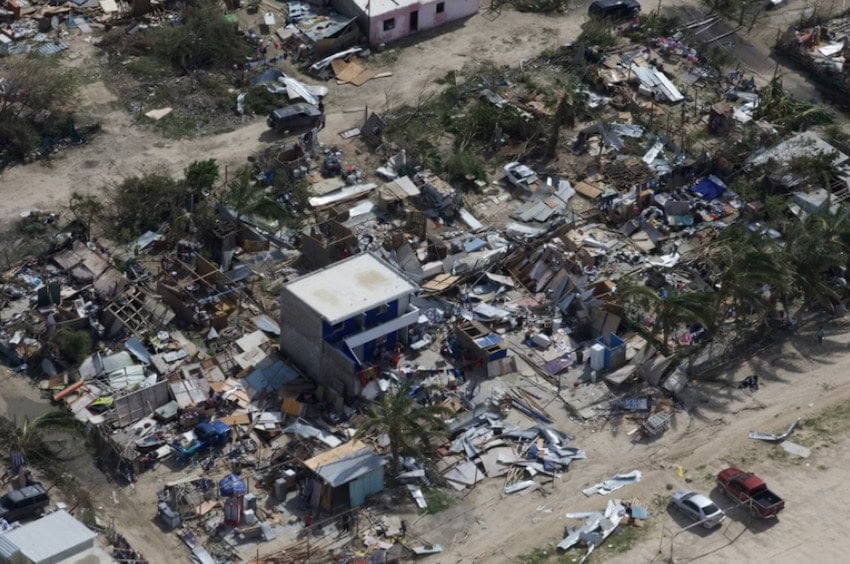

“This is the year we get hit by a major hurricane.” No one has said it in exactly those words. But I’ve heard the sentiment echoed in various ways by friends about Baja California Sur’s 2026 hurricane season (May 15 to Nov. 30 for the Eastern Pacific). As for the reasoning, it’s based largely on two things: the idea that we’re overdue — the region hasn’t experienced a catastrophic hurricane since Odile in 2014 — and the fear of a “ Super El Niño ,” which it appears there’s a good chance the current El Niño climate pattern may intensify into by November or December, potentially extending hurricane season beyond its official end date. Category-4 Hurricane Odile in 2014 was the strongest storm ever to hit the Baja California peninsula, leaving over a billion dollars in damage in its wake. (Gobierno de México) The “overdue” argument has no basis in scientific fact, of course. However, there is anecdotal evidence that suggests there is one major storm per decade that seems particularly destructive, and that lives on in the memories of regional residents: Liza in 1976 (the deadliest storm in the state’s history), Paul in 1982, Fausto in 1996, Juliette in 2001 and Odile in 2014, bringer of over one billion dollars in property damage, being the emblematic examples from the last 50 years. The Super El Niño, on the other hand — meaning simply a very strong El Niño with water temperatures 2 degrees Celsius or more above average — is a very real and very scary possibility. What could a Super El Niño mean for Baja California Sur’s 2026 hurricane season? Hurricanes can’t occur until ocean water hits a certain temperature: 26.5 degrees Celsius, or 80 degrees Fahrenheit . The warmer the water gets, beyond that point, the more likely hurricanes are to develop, the stronger and longer lasting they’ll be and the more prone to rapid intensification. So, supercharging temperatures by an additional 2 degrees Celsius (3.6 degrees Fahrenheit), the definition for a Super El Niño, on top of an already record-hot, human-warmed climate , is a recipe for disasters. El Niño itself is simply the warming range of the El Niño-Southern Oscillation climate pattern (ENSO), as opposed to the cooling of surface temperatures associated with La Niña. As of June 11 , per the National Oceanic and Atmospheric Administration (NOAA), the Pacific Ocean has entered the El Niño phase, with a certainty it remains at that level through the end of hurricane season and a 63% chance that it reaches the “very strong” threshold for the so-called Super El Niño phenomenon. If it happens, it would only be the fourth time in the last 50 years: following the 2015-16, 1997-98 and 1982-83 occurrences. The ocean has never been hotter In each of those cases, Super El Niños were associated with suppressed hurricane activity in the Atlantic Ocean, but strongly enhanced storm activity in the Pacific. However, in none of those years were the water temperatures as hot as they are now. That’s because, as the Institute of Atmospheric Physics at the Chinese Academy of Sciences noted last year, “The ocean is the hottest it has ever been recorded by humans, not only at the surface temperature but also for the upper 2,000 meters.” Sea surface temperatures in the Pacific were already heating up in May, a trend that will continue through the end of the year, and could reach Super El Niño status by November. (NASA) So a Super El Niño this year would take us into uncharted territory, with Pacific Ocean sea surface temperature raised beyond known limits. Projections for the 2026 season Whether or not Super El Niño conditions arise as expected, the Eastern Pacific region will almost certainly see above-normal storm activity during Baja California Sur 2026’s hurricane season due to the warmer water temperatures. NOAA is predicting 15–22 named storms for the 2026 season, 9-14 of which will be hurricanes and 5-9 will be major hurricanes (Category 3 or higher, with maximum winds above 111 miles per hour), a no
Esencja dla osób, którym nie chce się czytać całości.
- 01With all-time high Pacific Ocean temperatures and a potential Super El Niño coming, this year's hurricane season could be stormy in Baja California Sur.
- 02The post MND Local: Hurricane preparedness and fear of a ‘Super El Niño’ in Baja California Sur appeared first on Mexico News Daily
MSM Poland agreguje i streszcza najważniejsze informacje z różnych źródeł.